Petra/ Jordan

Jordan/ Petra

A country that I always associated with the river and song: ‘deep and wide, chilly and cold, chills the body and not the soul!’

Well it doesn’t chill at all, though it is not as hot as I anticipated. Such a contrast to Egypt…the first thing that changes is the smarm looking for baksheesh. It was probably the single most uncomfortable thing about Egypt, maybe even worse than at home.

Here is pleasant and friendly. We got our car at the airport with smiles, great politeness and not the slightest sensation of ‘when in the world are you going to tip me?’

The gps found us a lovely route to Petra, one part of it was undulating hills with scrub vegetation, flocks of sheep and thistle growing – uncannily akin to Scotland! For the rest it was desert, with a sprinkling of agriculture and industry. Olives and cement.

Wadi Musa the little town adjoining Petra is sprawled up and down the hills in muddy brown, quaint and charming. Our hotel is a lovely old one, beautifully maintained and superbly serviced. Sitting out on the terrace and watching the sunset over the hills. Bedouin tea and a really superb dinner buffet. So pleasant after the bad food in Egypt. The hotel is the Amra Palace International Hotel, and I can solidly reccommend it for great cleanliness, helpful charm and very good food. It’s a little distance from the entrance to Petra, but they have 3 shuttle busses morning and evening. The closest hotel to the entrance is the movenpick, which looked rather good too, however I liked the character of the Amra.

Tomorrow we go explore the depths of the city in stone.

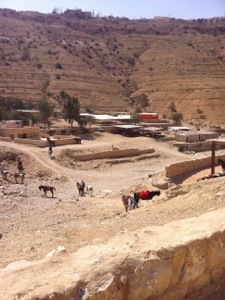
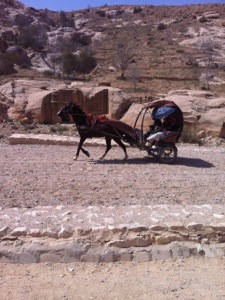
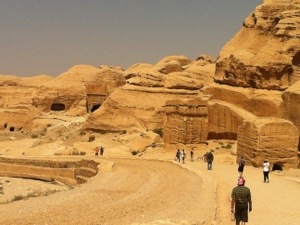
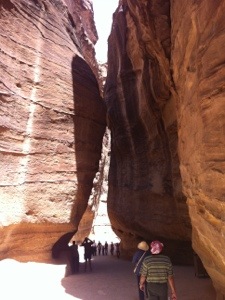
Petra; it starts with a dusty path, alongside the horse track, with the carts and horses throwing up plumes as they come asking if you would like a ride. But then you walk into the shady mouth of a narrow canyon. It is the Siq which forms a passage into the main city. Textured pink rock, carved with old water channels either side and various points with icons and deities all weathered in pink stone. There is a saying that this is where Moses smote the earth and water sprang forth. Moses or not, there is a spring and the early Nabateans who built this city controlled the water, channelled it and made reservoirs, creating a perfect stopping point for cross traffic in all directions and earning from their great resource in the desert.

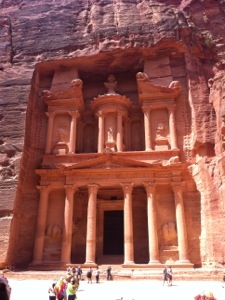
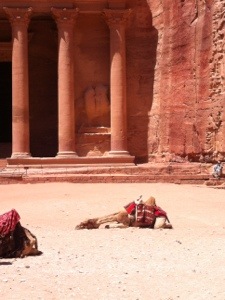
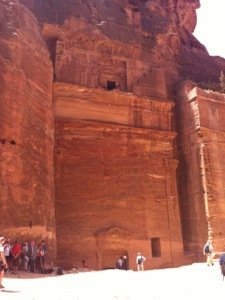
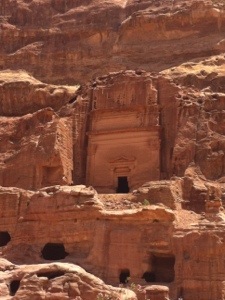
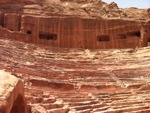
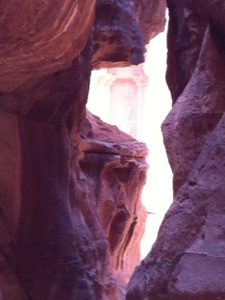
The Siq winds it’s way into the mountains and emerges you at the point where the most famous Petran monument, the Treasury appears. ( Straight out of Indiana Jones, you can imagine Sean Connery and Harrison Ford charging out of the canyon while ‘Petra’ explodes behind them.) Here the valley opens and one has a surfeit of amazing sculpted rock in every direction. Temples, tombs, cisterns, roman colonnades, a theatre. Crusader castles and the beautiful monastery on the hills. It’s about 12 kms of hot wandering and clambering. Not for the faint hearted.

You can take a horse, donkey, camel to do sections, but it is honestly best explored wandering, with a large hat, a camel back water pack and some chocolate for energy. Start early and take the whole day, or take two days. The ticket cost a dinar or two extra over the basic cost, for each day.

After the hot dusty Petra walk and all that culture and art, the Turkish bath is a must. They steam you and scrub you, pummel and massage all the wellness back in, you emerge; new, refreshed and ready to go back again, however i went and sat on the terrace with an icy beer and watched the sunset.

The old ones certainly knew how to build timelessly!

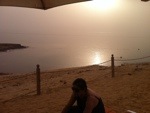
We drove via the Dead Sea and spent a night there on our way back to Amman and the flight out. The Kempinski Ishtar hotel is large and 5 star with its own private beach – so nice. The Ishtar section is nicer to stay in, and the movenpick next door seemed equally nice.

The Sea is its own amazing experience of just staying on the surface of the water and barely managing to put your feet down on the ground. Hilarious to start with and wonderfully relaxing once you have the measure. Don’t let it get in your eyes or mouth, stinging and foul. Great for the skin, even if you do not coat yourself with the black mud, smoothens and shines making you gleam. We had a thunderstorm and rain in the desert to add value to an already amazing trip.

Sent from Pavane Mann’s iPad
Ph: +91 9810184360
http://www.outwardboundindia.com
http://www.himalayanadventure.com
http://www.pavanemann.com
20130503-172539.jpg

20130503-172630.jpg

20130503-172659.jpg

20130503-172803.jpg

20130503-172856.jpg

20130503-172918.jpg

20130503-172945.jpg

20130503-173034.jpg

20130503-173401.jpg

20130503-173505.jpg

20130503-173418.jpg

Egypt 2013

Egypt:2013

The last time I came to Egypt, I saw the Nile only as a line of green from the aircraft and I wanted so much to explore the romance of it. But, I was exploring the romance of the desert and it’s oases, the library at Alexandria and the war stories of El Alamein, so the Nile stayed a dream for another time.

Now I am sitting on a ship on the Nile. The desert spreads out on one side, with some ancient ruins and a tiny temple on top of a dune. The city of Aswan is on the other.

Yesterday we had a most amazing drive through the desert, miles and miles of it to visit the temples at Abu Simbel. That they moved all that way to build a temple in some obscure part of the Desert, just boggles the imagination. Obviously the Nile was the connector and they used it as a roadway as well as everything else, even so the size and precision of the construction and the amazing detail of frescoe and carving are astounding, as everywhere in Egypt. That it was Ramses proclaiming sovereignty over Nubia is all understandable, what amazes is the feat of such incredible construction in the midst of no where or what, perhaps today, appears random and the importance has been lost, literaly in the sands of time.

What is much more amazing is that it was lifted from its original spot and moved higher to prevent it being submerged by the waters of the lake once the dam was built. So starts my sojourn with classical Egypt.

I have spent the most interesting afternoon boating across the lake to visit the island of Philea and the amazing temple of Isis, there. A temple that was partially submerged by the dam and finally moved to the island, another amazing feat – it seems to have been perfected here, and truly looking at the art on those walls, it would have been sacrilegious to have drowned it. It is a temple that combines the Pharaonic, Greco and Roman styles, and you can see where the early Christians have defaced many of the amazing carvings because of their paganism.

There is a particular story of Hathor’s nurturing of Horus, from childhood to teenage and the artists depiction is of her still nursing him to show that, so easily misunderstood by a tight mind, and the complete defacement of her face proves it.

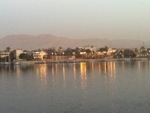
We are now seated on the deck of the ship watching the lights reflecting in the swift flow of the Nile. A wonderful day.

The boat sailed just before sunrise this morning, along the river, green palmed banks, backed by the golden desert. We stopped at the temple of Kom Ombo, a double temple to the gods Horus and Sobek. Being on the banks of the Nile and infested with crocodiles, the people of the area decided Horus was not enough protection and started to worship Sobek as well, thus, the small temple of horus was rebuilt into a large temple with shrines to both, and high priests that had secret passages and managed to amass huge wealth by talking through tunnels misleading the rich and able contributors into huge donations. They even had a secret passage to escape if their treachery was discovered, which led first into their storage room and then out, so they could retrieve the most precious of their treasures.

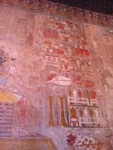
There was still colour in patches, and one can imagine how intricately it was painted and just how vibrant it must have been. They used oxides, so the obvious blue, red and yellow have sort of survived in patches, because the stone has absorbed it. They must have been totally brilliant in their hey day. The bits that survive are intricate with detail, patterns and weaves on the clothes and perfectly formed appendages, it must have been an amazing work.

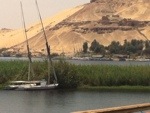
We continue to float along this mighty river, with the life along its banks. Fields of sugar cane, people washing their clothes and bathing. Feluccas in full sail.

Our next stop is Edfu, a dirty little city with the most complete temple that exists in this part of the world. A tonga ride took us to the temple. Another temple dedicated to Horus, but here we could see how they must have actually been, with the roofs and columns almost intact, the inner sanctum and the storage rooms. We have a most learned guide, he makes the panels come alive as he tells the stories depicted which makes a visit to the temple much more than just a wander around an ancient shrine. Of course the early Christians tried to destroy this too, but it was too large and with too much work, so they tried to burn it down. That did not happen to solid rock, but it defaced the colours completely, finally they did all of mankind a favour and decided to bury it, leaving it for posterity to discover, relatively well preserved and complete.

It is a brilliantly moonlit night on the steadily widening Nile. There is more habitation along the banks and much as I would have enjoyed a small felucca cruise more, this has been rather enchanting.

Luxor, the place of kings. How did they discover a mountain that looked like a pyramid and decide to use it as their burial ground? And those tombs, white limestone painted brilliantly, an amazing concept, a whole valley dedicated to untold riches. When you look at the treasures recovered from the most current tomb of Tut ankh Amon, a young, lesser pharaoh, the mind tries to absorb what must have been stolen and melted down through the ages, absolute fortunes of incredible artefacts.

Then the largest temple complex at Karnak, mammoth pillars, huge carvings, stories unfolding on the walls, generations of them, beautifully carved and depicted with such detail and finesse. Colonnades, avenues of sphinx, leading to the temple at Luxor. The ancient ruins house an incongruous, newer mosque, but it is so hard to impose on the grandeur of the earlier structure, that it overshadows all.

It has been a surfeit of immense, man created phenomenons all flowing along with another incredible river, a body of water that greens a desert and allows a civilisation. I will have to visit the Nile again, it is yet unexplored.

Sent from Pavane Mann’s iPad
Ph: +91 9810184360
http://www.outwardboundindia.com
http://www.himalayanadventure.com
http://www.pavanemann.com
20130427-100537.jpg

20130427-100931.jpg

20130427-101002.jpg

20130427-101030.jpg

20130427-101042.jpg

20130427-101100.jpg

20130427-101128.jpg

20130427-101149.jpg

20130427-101209.jpg

20130427-101256.jpg

20130427-101348.jpg

Romancing travel

Today I did a twelve hour drive, off roading through the desert and dhanis from Jaisalmer to Osiyan. There were amazing dunes to cross and some very nice people to travel with. But over it all was the intrinsic quality of the desert and it’s peole. The shepherds and the lohaars, the kal beliyas and the bishnois. Each with their own particular characteristic, weather the art of herding, the art of the troubadour or the art of firing metal in a little pan with a jury rigged blower made of a cycle tyre. The mould is made in the sand at his feet and he churns out all the sickles, knives, spades, blades that the people need. The Bishnoi and his animal protection allow one to see myriad deer and other little animals around their lively settlements.

I am now sitting in a fairy tale camp at the edge the desert, a train just went past with its attendant lonesome call – straight out of ‘Pakeezah’. I have heard the most heartily sung ballads and sat around a bonfire under a star filled desert sky.

It never wanes that romance of a bonfire and starlight- how many years of recounting a similiar story but the magic lives on.

Rural Maharashtra and the ‘hill stations’.

20130130-083513.jpg

20130130-083441.jpg

20130130-083406.jpg

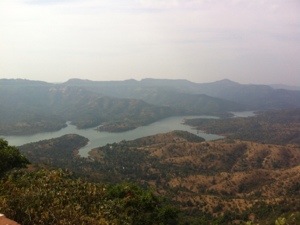
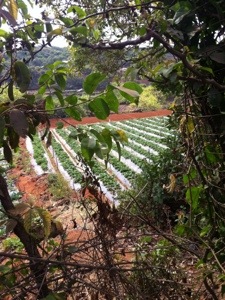
This morning I drove out of Bombay, it is hard to do because it’s an almost never ending city. However we got to the ghats still clothed in mist and climbed up to the strawberries.

There’s indescribable beauty, huge boulders of mountains, forested, road lined with large banyans with hanging roots. Suddenly you come to a corner spouting a tinted blue waterfall falling over cement rocks? Nature did not do it well enough, we will better it!

Picture perfect little strawberry fields, full of people picking and posing for photographs. Every few turns bring an ATV track, old and young furiously driving mindlessly around in circles between used tires.

Pink, yellow, green resort buildings with large signages all but obscuring the lovely vistas that you have ostensibly come to see. Panchgani and Mahabaleshwar. The retreat in the hills.

Now I find myself sitting a half hour drive out of Mahabaleshwar, it’s a tiny village, the Jai Bhawani hotal serves a mean maharashtrian thali. The store next door has only two real cotton saris which we promptly bought.

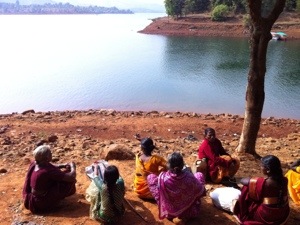
The car is parked under a large peepul tree beside the temple, we walk a few meters past down to the banks of a huge, sparkling lake. A gaggle of multi hued ladies sit under the tree waiting for the phut, phuting, colourful boat that soon appears to take us across the lake to the far shore.

There is no one and nothing here but pristineness. We are come to see this little camp, irrelevant, other than that it provides an un intrusive way to to stay in the surrounds of this little place that actually exists just a short way away from the ugly tourist hub.

A moonlit night casts it silvered spell over a silent expanse of water, there are only three visible lights. The magic in my life continues.

Sent from Pavane Mann’s iPad
Ph: +91 9810184360
http://www.outwardboundindia.com
http://www.himalayanadventure.com
http://www.pavanemann.com
20130130-083554.jpg

20130130-083629.jpg

It’s Bombay

20130130-082919.jpg

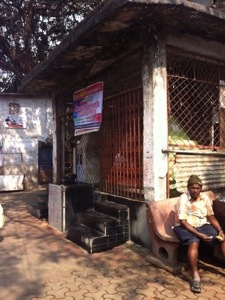
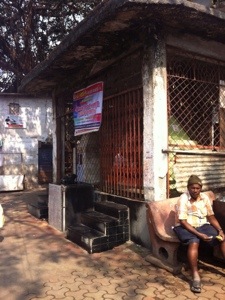
The not so little village of Bombay, the cobblestone streets of what we used to call the suburbs. Mainstream Mumbai of today with happening corners and still interesting village alleys rubbing shoulders with each other. A walk able pavement, but an ‘ istriwala’ blocks half, the next section is taken up by a lovely old peepul tree with a quaint temple around it.

That lady with her cotton dhoti and chequered blouse carrying the smart shopping bag works in 4 different flats. Speaks a smattering of English, does the daily shopping for all four workplaces, cooks their meals in record time and retires to her little basti around the corner where chickens still run in the street, the fish lady brings her basket around in the morning and a smart little advertising executive rents the little room above her house. They have village weddings and rocking parties in the little courtyard and each deals with the loud music of the other.

In every area, around almost every corner is a happening little bar or restaurant, you can aspire to pay huge sums for some well presented, pretentious piece of art on a plate or pay a quarter for a sumptuous feast of great fish curry and rice. Street corners sell health food and junk food in adjacent stalls.

The bread man still brings a bag full of goodies to your door, you could actually wake up to the cawing of the birds in the great tree outside your window. You get transport from anywhere to any where at any hour of the day or night.

It’s all rather dirtily swept, there’s a pervasive odour of ‘Bombay’, the sense of fashion is completely individualistic, you get glamour, style, funk, comfortable, ill fitting and downright nothing, but all worn with a sense of ease. There is zest, purpose and busy ness all around, the drivers are polite and they all have a story.

I so enjoy this city.

Sent from Pavane Mann’s iPad
Ph: +91 9810184360
http://www.outwardboundindia.com
http://www.himalayanadventure.com
http://www.pavanemann.com
20130130-083157.jpg

20130130-082813.jpg